Milton Avery and the Figure
By Laura Heyrman
"The idea is in my head, to put it down is nothing." – Milton Avery (American, 1885-1965)
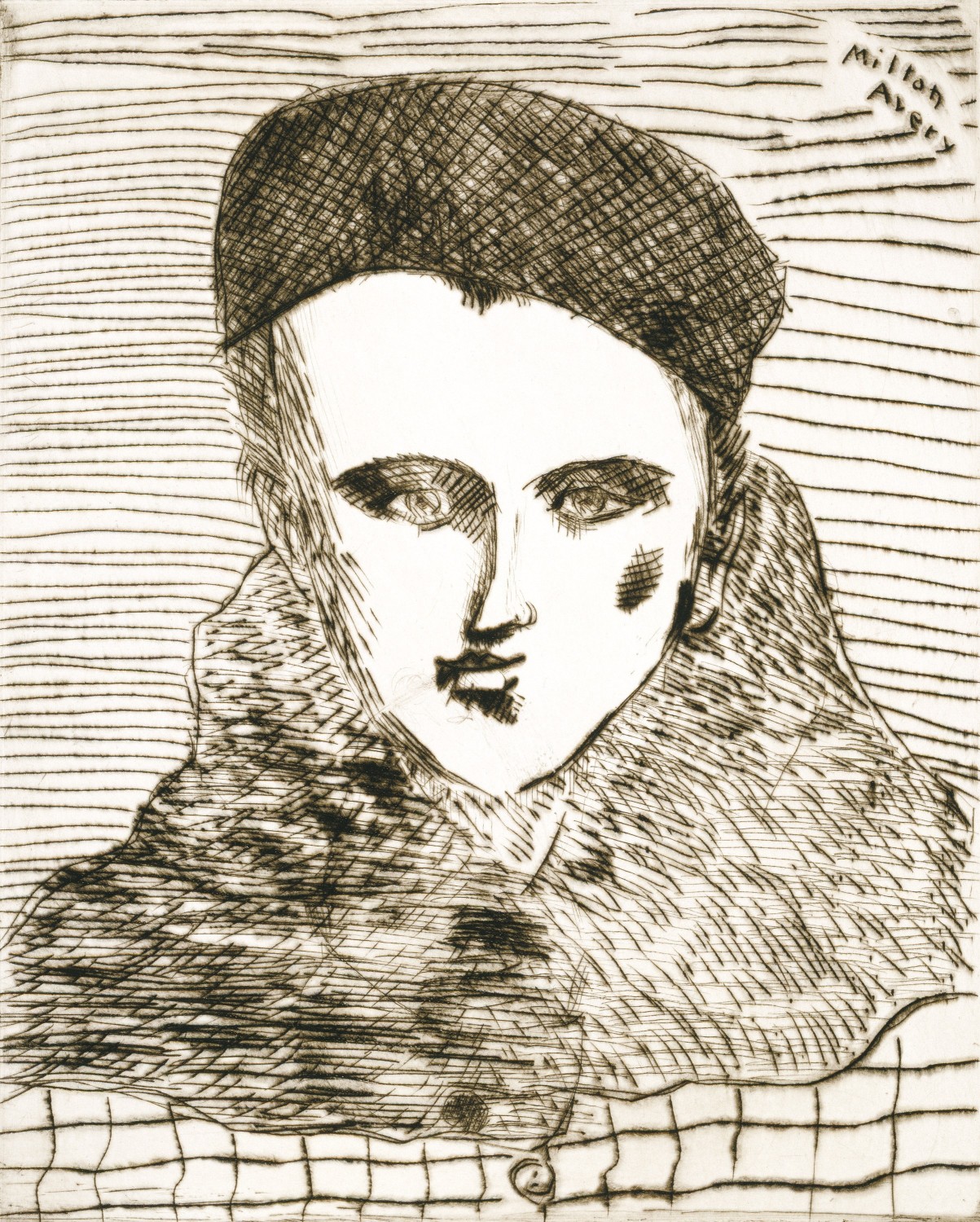
Inspired by the current exhibition of Milton Avery’s figurative work at Karma in Los Angeles, this Viewing Room focuses on that aspect of the artist’s career. The exhibition, which was shown at the gallery’s New York location at the end of last year, is the first survey dedicated to Avery’s figural images.
Avery is less well-known than many of his contemporaries. This perhaps can be explained by the fact that early in his career, the artist’s abstraction was considered too radical ,while later in his life, his representational subjects were seen as old-fashioned in contrast to the rise of Abstract Expressionism. In spite of these attitudes, Avery had friendships among the New York avant garde from the 1930s on; Mark Rothko (Latvian-American, 1903-1970) was a particularly close friend who described Avery as an “anchor” for younger artists like himself. (For more on Rothko, see irequireart.substack.com/p/chance-encounters-edition-10.)
“Art is like turning corners, one never knows what is around the corner until one has made the turn.” – Milton Avery
Avery was born to a working class family and apparently showed no interest in the arts as a child. He began working in a factory when he was 16 to help support his family and by 1915, he was the sole support for nine female family members. The artist took his first drawing class at the Connecticut League of Artists. He had intended to take a lettering class to develop a marketable skill, but it was full. Falling in love with art, Avery took as many classes as he could; he worked as a nighttime file clerk so he could take day classes and make a living at the same time.
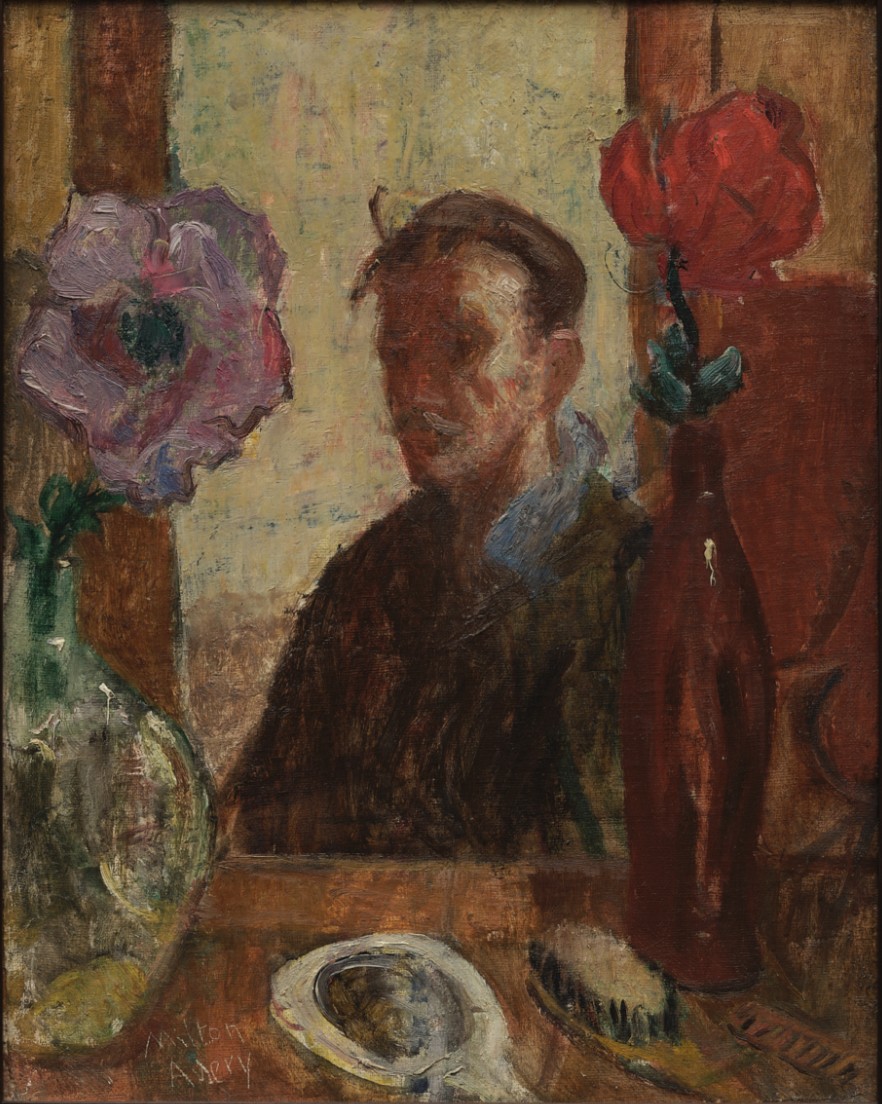
In 1927, at the age of 40, Avery moved to New York. He married fellow artist Sally Michel (American, 1902-2003) who wholeheartedly supported his ambition and in their early years together, the couple depended on her earnings as a freelance illustrator. The artist’s wife and his daughter March (b. 1932) were his favorite models and appear in several of the works in this slide show.
Friends, family, and quiet interior scenes dominate Avery’s figurative work, so it is not surprising to learn that French painter Édouard Vuillard (1868-1940) was one of the European artists in whom Avery took an interest. Vuillard was a participant in the movement called Intimism, which focused on depictions of quiet interiors and mundane household activities. Though the two artists’ styles and techniques differed, the serenity of their homely scenes shows Vuillard’s influence on Avery.
The other European artist who attracted Avery’s admiration and whose influence is clear is Henri Matisse (French, 1869-1954). Some critics even referred to Avery as the American Fauve, a reference to the early 20th century art movement of which Matisse was a founding member. (For more on Fauvism, see irequireart.substack.com/p/chance-encounters-edition-22.) Once Fauvism had ended, Matisse, like Avery, maintained independence from the popular trends in art. For a time, Matisse was also underappreciated and viewed as an artist who had fallen behind the avant garde. Matisse’s skillful manipulation of color attracted Avery, and like the older artist, it was Avery’s color sense that drew critical approval.
“I am not seeking pure abstraction; rather, the purity and essence of the idea – expressed in its simplest form.” – Milton Avery
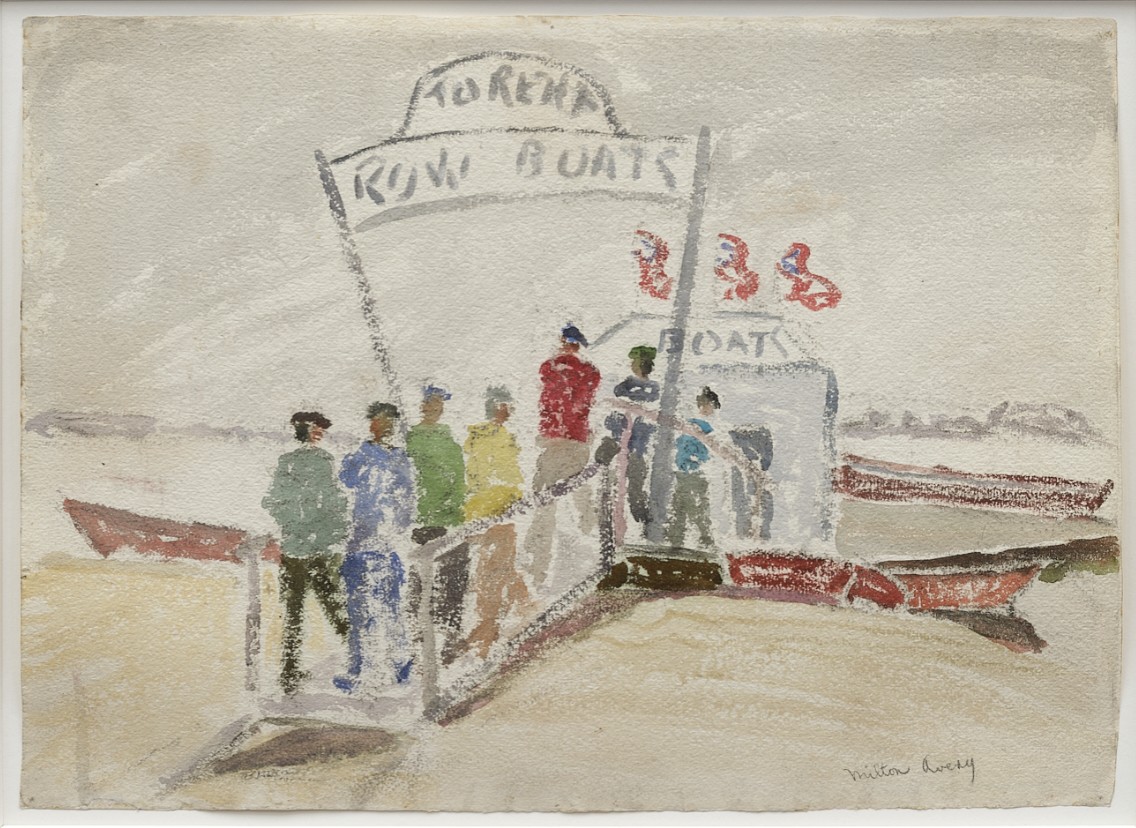
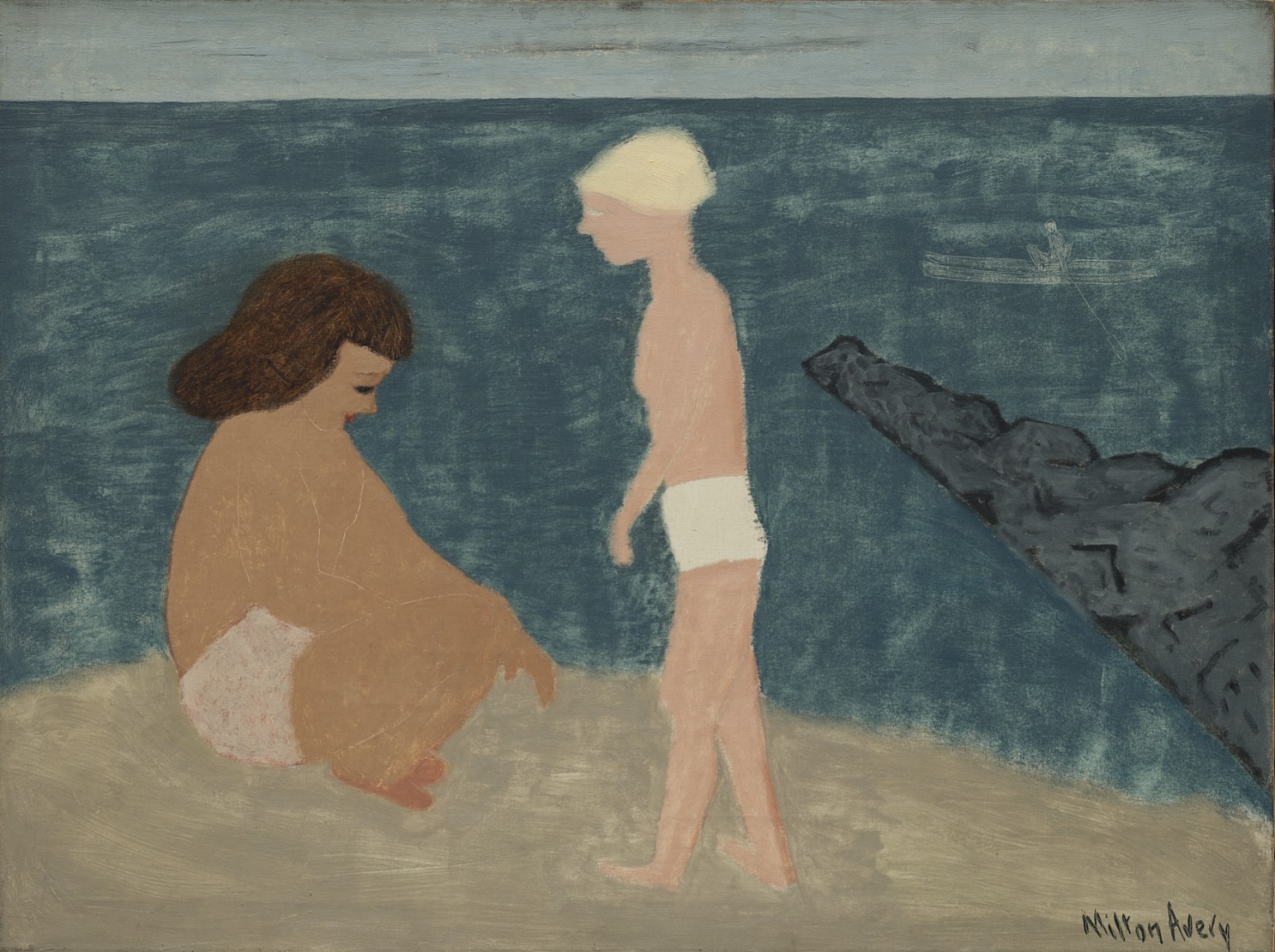
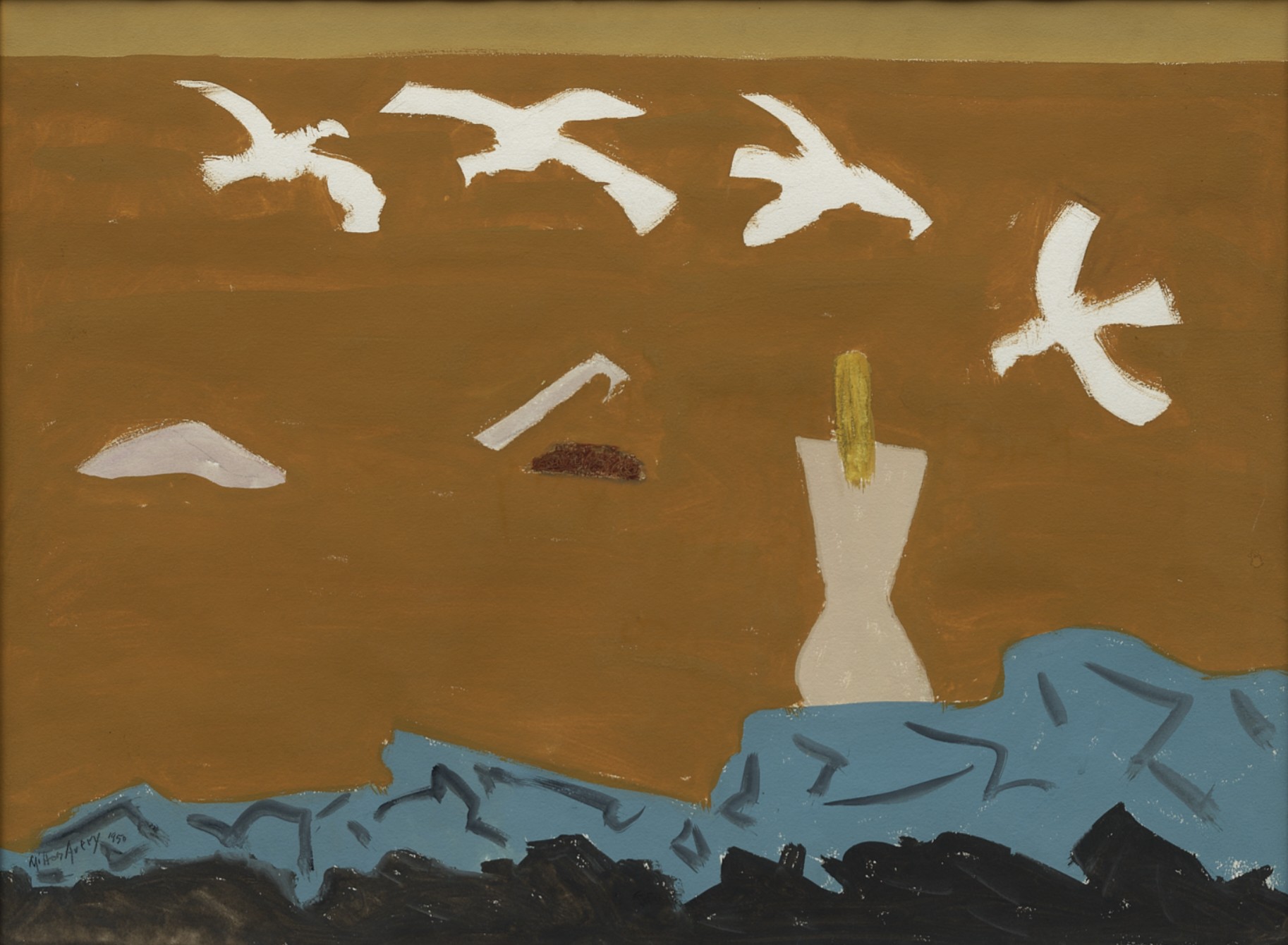
By 1935, Avery was exhibiting regularly and achieving success. Though he and his family never became wealthy, they were able to get out of the city for summer vacations at beaches in New England. Just as home life filled Avery’s art, so too the family at play on beaches and piers can be found in his work. his work. (Avery’s landscapes, especially of beaches, are worth seeking out, though they are outside the scope of this Viewing Room.)
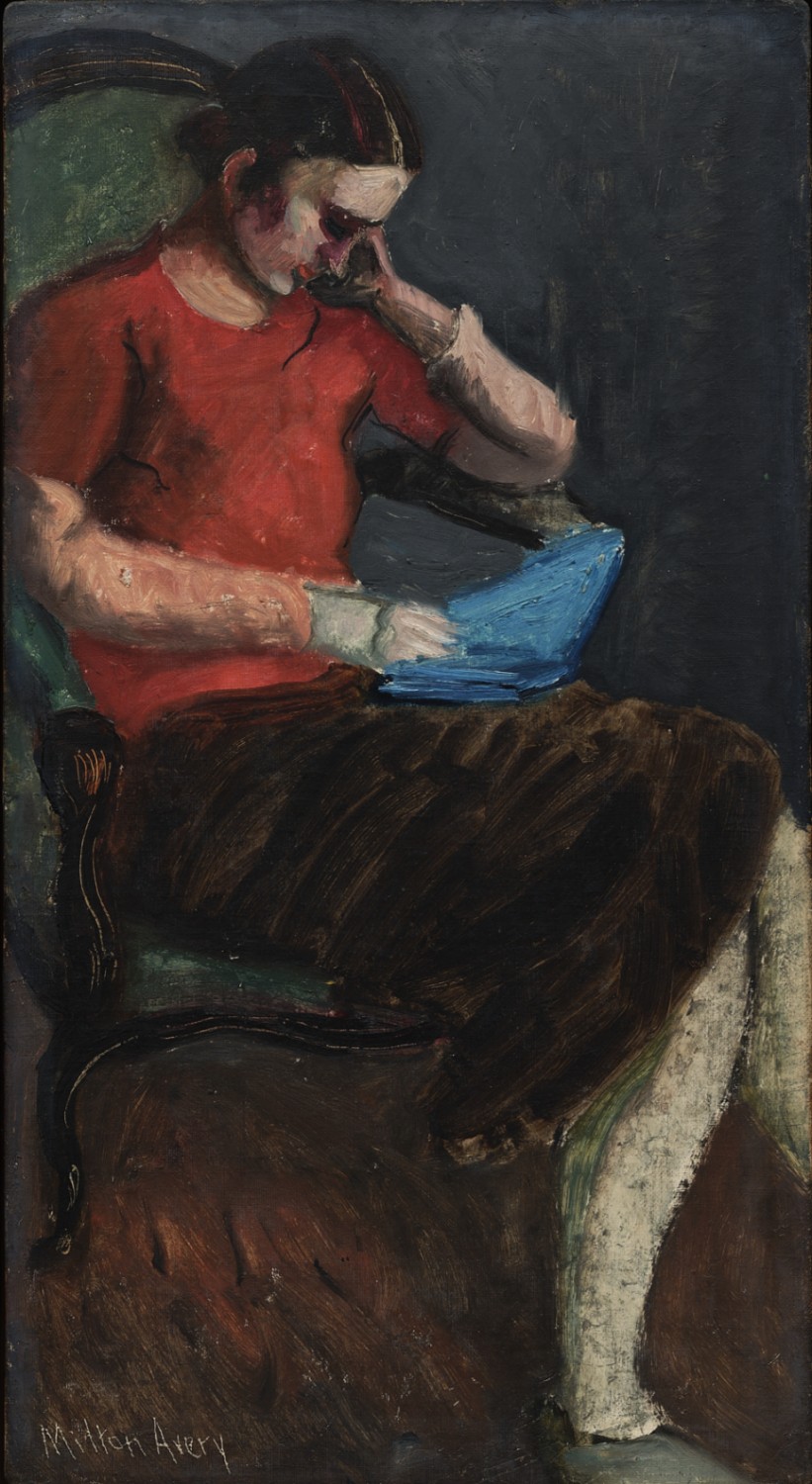
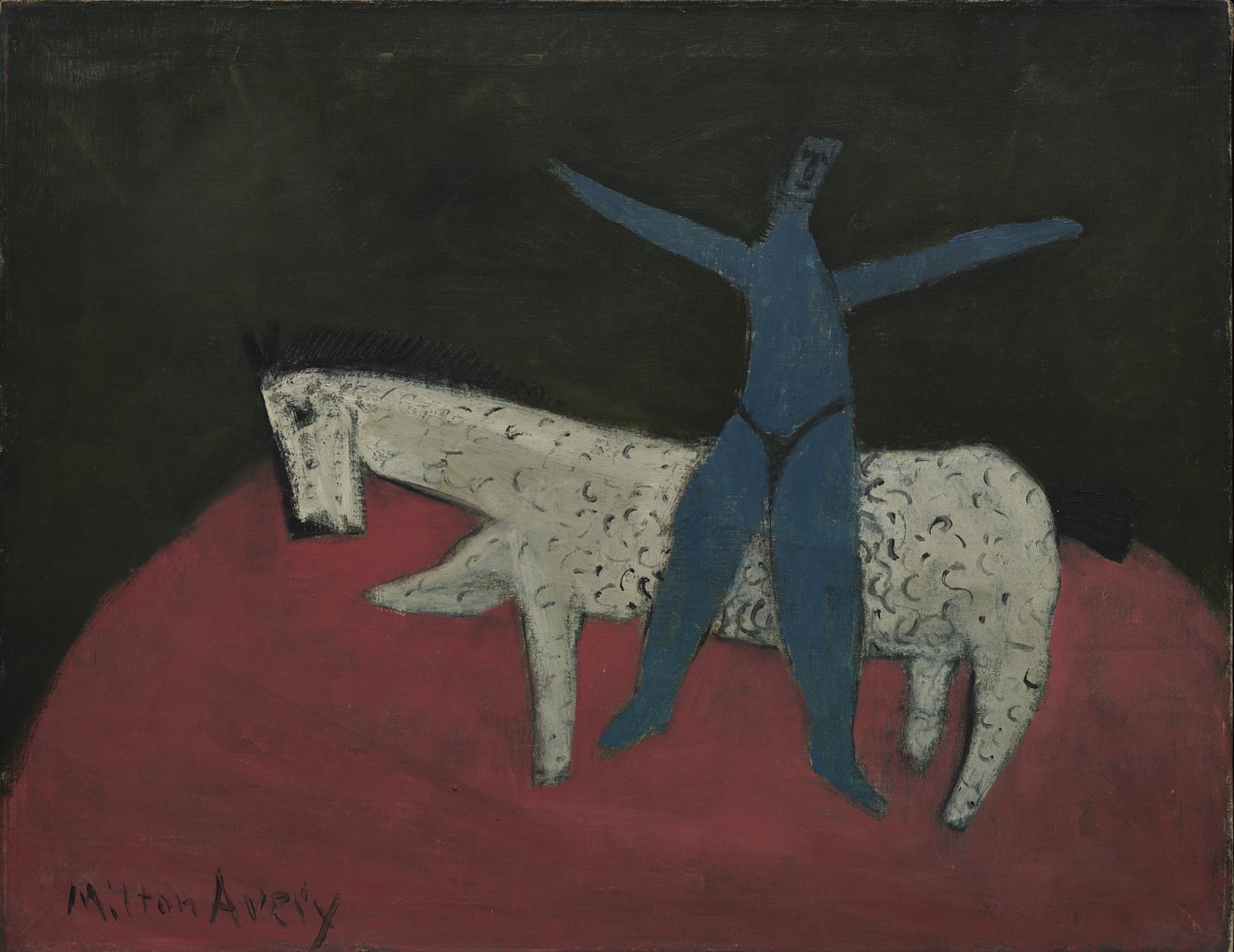
As the works in the slide show below demonstrate, the artist’s earliest works were conventional in style; a painterly but naturalistic approach was most common in the late 1920s and early 1930s. Fairly quickly, Avery began to incorporate the lessons he found in Matisse’s works and to move toward the abstraction that marks his mature style. In this slide show, that development can be seen by comparing the traditionally shaded and mostly naturalistic The Reader from 1931 and the highly simplified Children at Seaside of 1935. In spite of the abstraction of shapes in the latter painting, Avery kept the colors naturalistic. However, that changes by the time we reach 1939’s Circus.
“I try to construct a picture in which shapes, spaces, colors, form a set of unique relationships, independent of any subject matter.” – Milton Avery
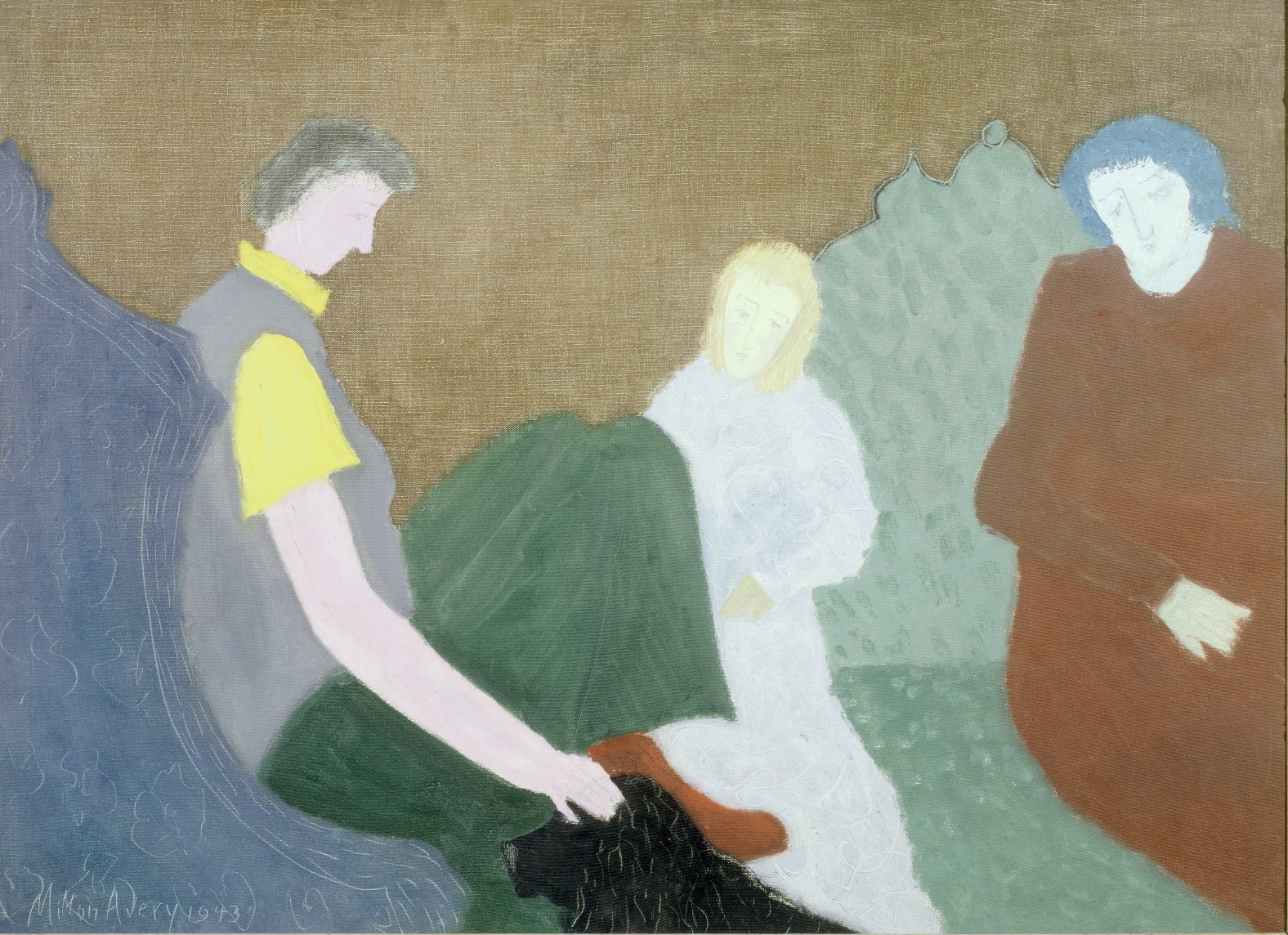
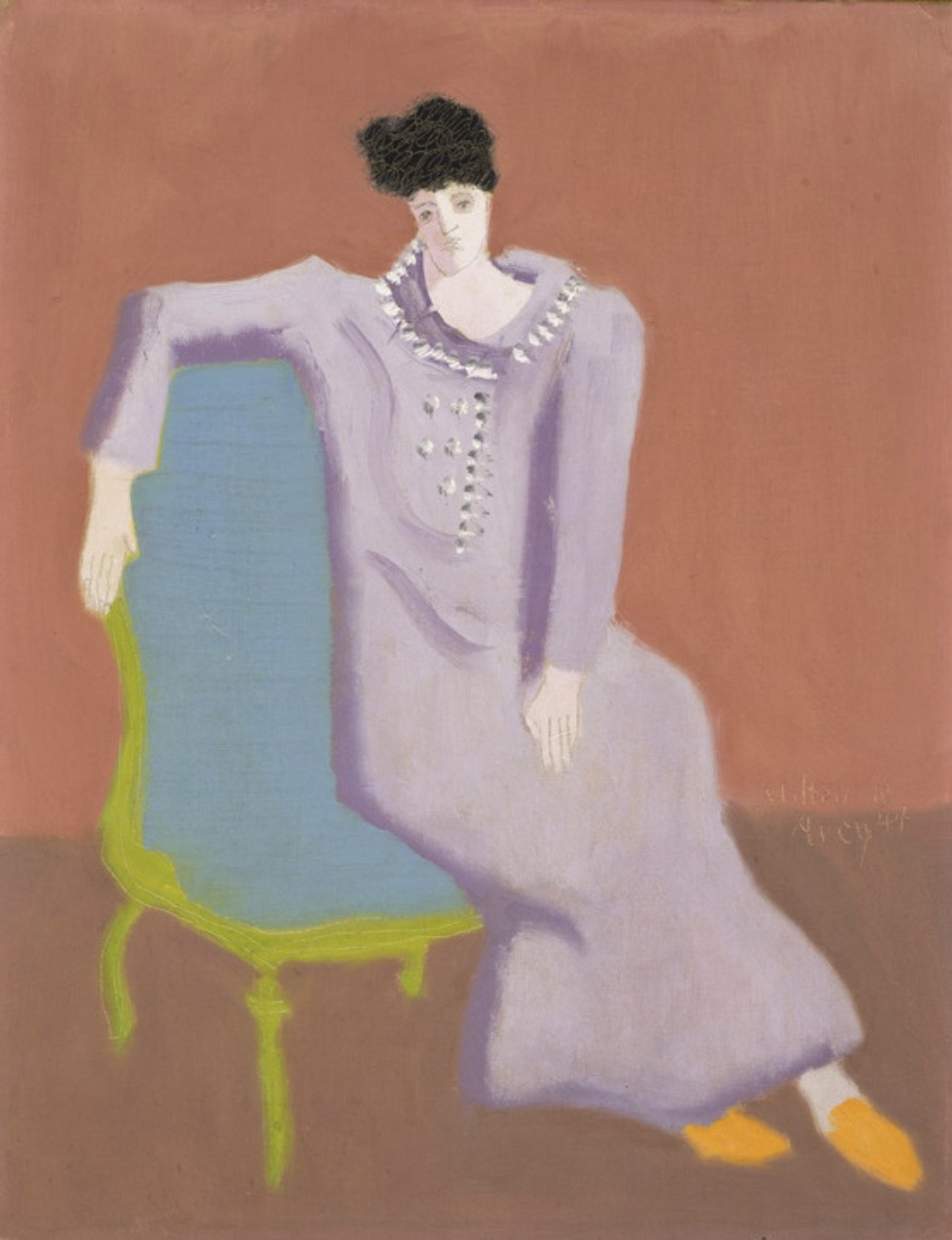
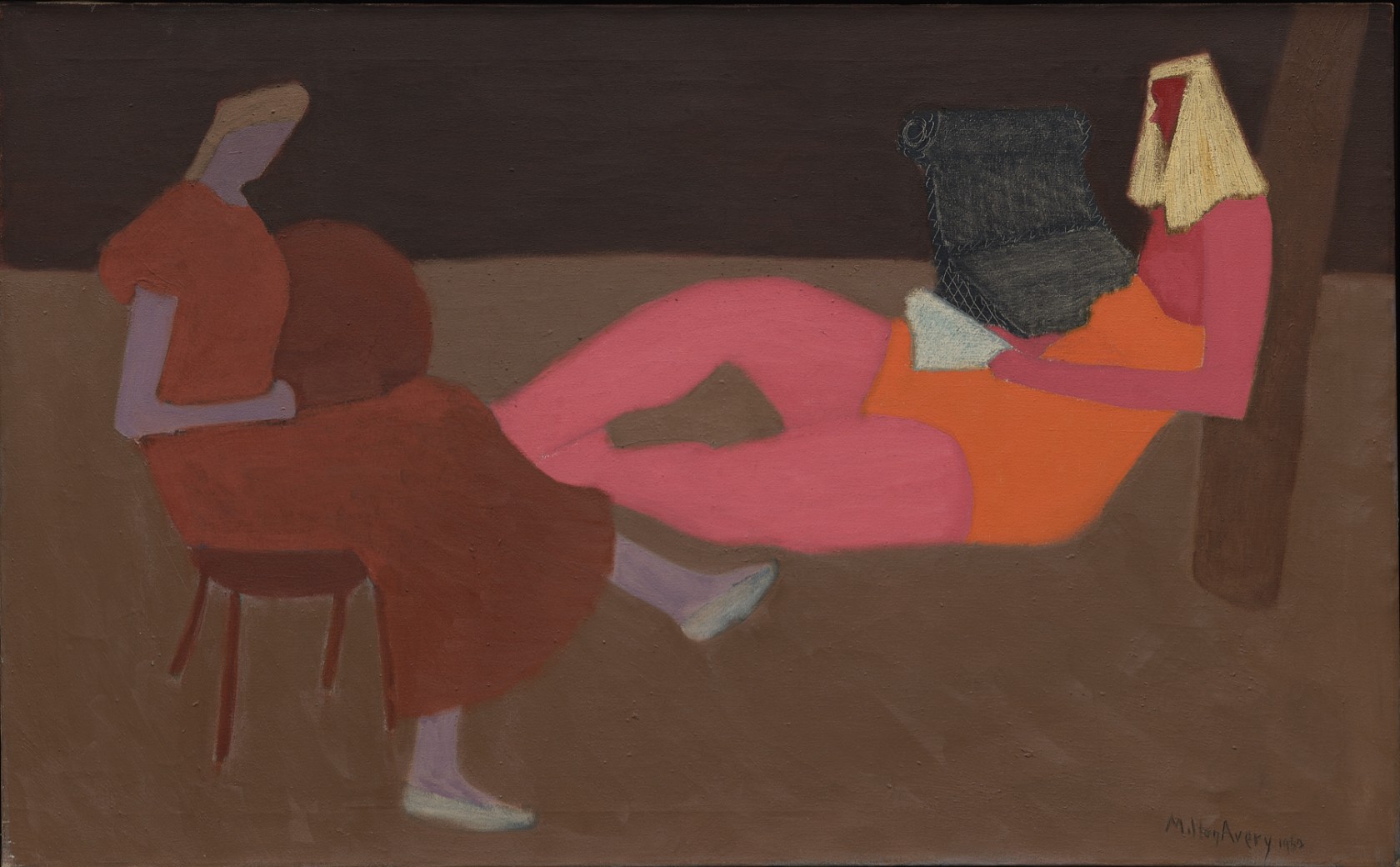
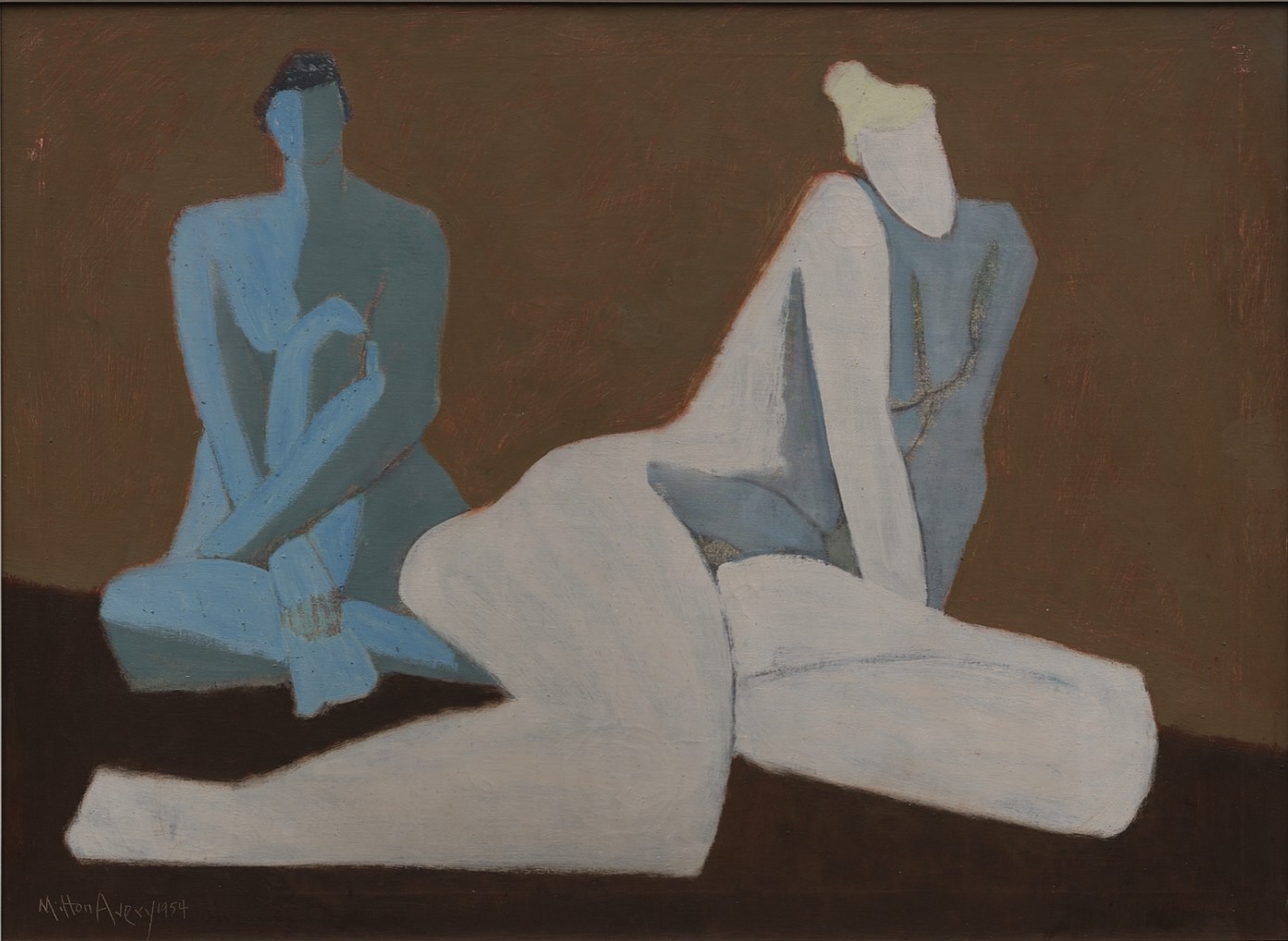
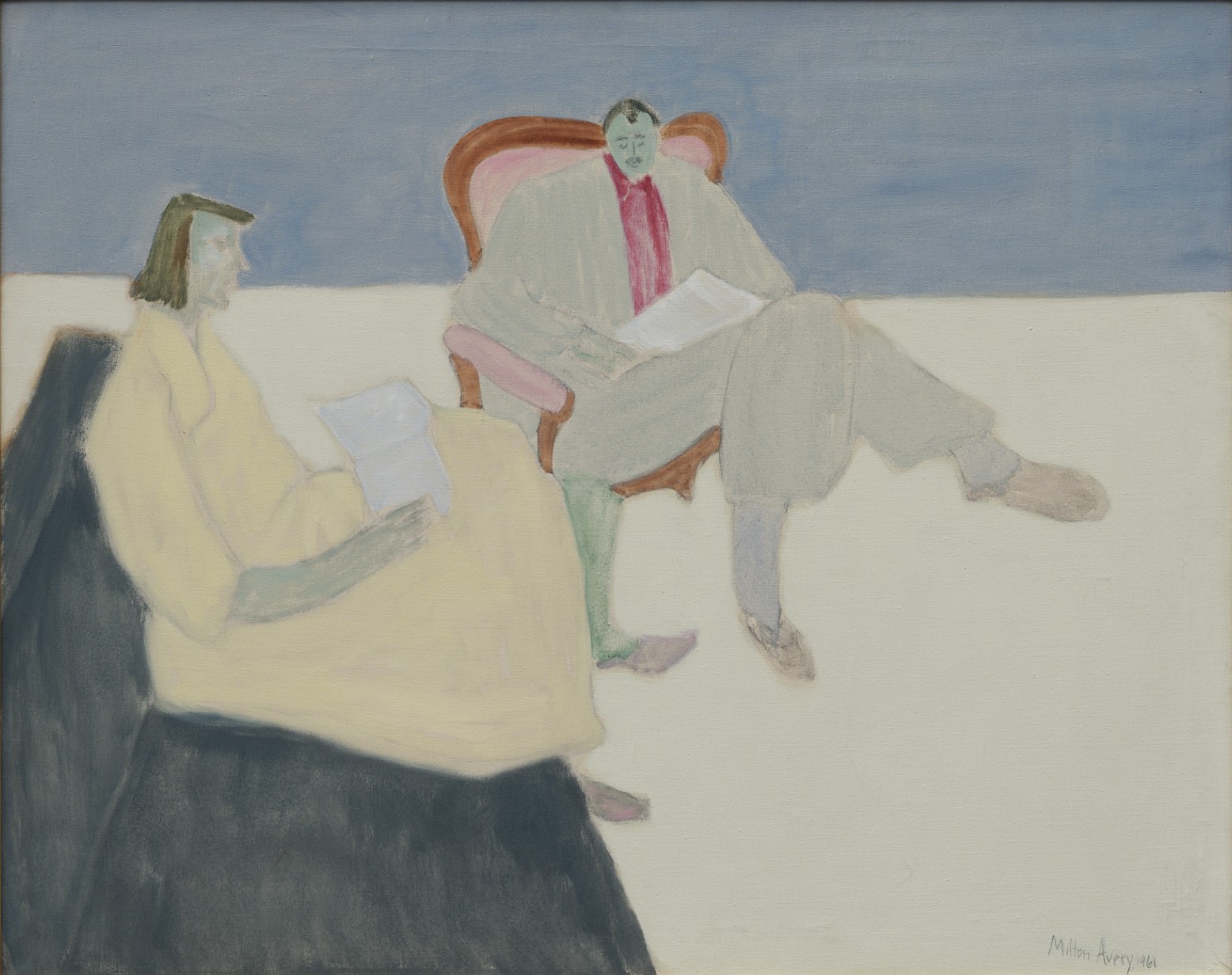
In the works Avery created from the 1940s on, we can see the artist developing the techniques and color theory that drove his mature works. In Three Figures and a Dog from 1943, the warm-toned background at the top of the painting is painted with a dry brushing technique. The effect is subtle and one needs to look closely to see the crisscrossing lines made by a brush’s bristles. In the blue shape at the left, the artist turned his brush around and, with the handle's end, incised fine lines in the wet paint. Avery used the same technique to give texture to the dog’s fur. In many of his paintings, Avery limited his palette to just a few colors; his preference was for three. He felt that otherwise the clarity of all the colors would be obscured. In the slide show, this is most noticeable in Lady Seated (1944) and Two Nudes (1954). Husband and Wife (1961) demonstrates another of Avery’s preferred methods, working with paint that had been thinned with turpentine to create an airy or translucent effect. The artist even experimented with stained canvas techniques before the technique was used by Color Field painters like Helen Frankenthaler (American, 1928-2011) and Sam Gilliam (American, 1933-2022). (For more on Gilliam, see irequireart.substack.com/p/viewing-room-15.)
“I never have any rules to follow. I follow myself.” – Milton Avery
In 1949, Avery suffered a massive heart attack which limited his ability to work on a large scale. He created many prints and paintings on paper during his convalescence before returning to oil painting. The 1950s was the time when the artist’s popularity declined, though his style and subject matter were unaffected. A second heart attack in 1961 further weakened the artist, but he continued to paint his favorite themes until 1964. The artist died early in 1965; over 600 people attended his funeral including many friends from the New York art world. His long-time friend Rothko spoke at the funeral, calling the artist “a great poet inventor” from whom “we have learned much and will learn more for a long time to come.” In addition to his influence on Abstract Expressionist and Color Field painters, Avery’s work has influenced more recent artists for whom color is the carrier of mood and memory, including Mary Weatherford (American, b. 1963, see davidkordanskygallery.com/artist/mary-weatherford), Clair Bremner (Australian, b. 1981, see clairbremnerart.com/home), and Peter Doig (Scottish, b. 1959, see moma.org/artists/8087-peter-doig).
“Why talk when you can paint?” – Milton Avery
Exhibition:
Milton Avery: The Figure, through April 11, 2026, at Karma, 7351 Santa Monica Boulevard, Los Angeles, California, USA. karmakarma.org/exhibitions/milton-avery-la-2026
Please share your comments and questions on Substack. LINK irequireart.substack.com/p/viewing-room-48/comments
Longer captions may not be fully visible on smaller screens. We apologize for the inconvenience.
If the caption obscures part of the artwork, click on the image to turn off the caption.